Drawing study suggests shared movement patterns can aid early learning
Yale researchers found that practicing rotated symbols improved performance on the originals, but the experiments did not test lasting benefits.
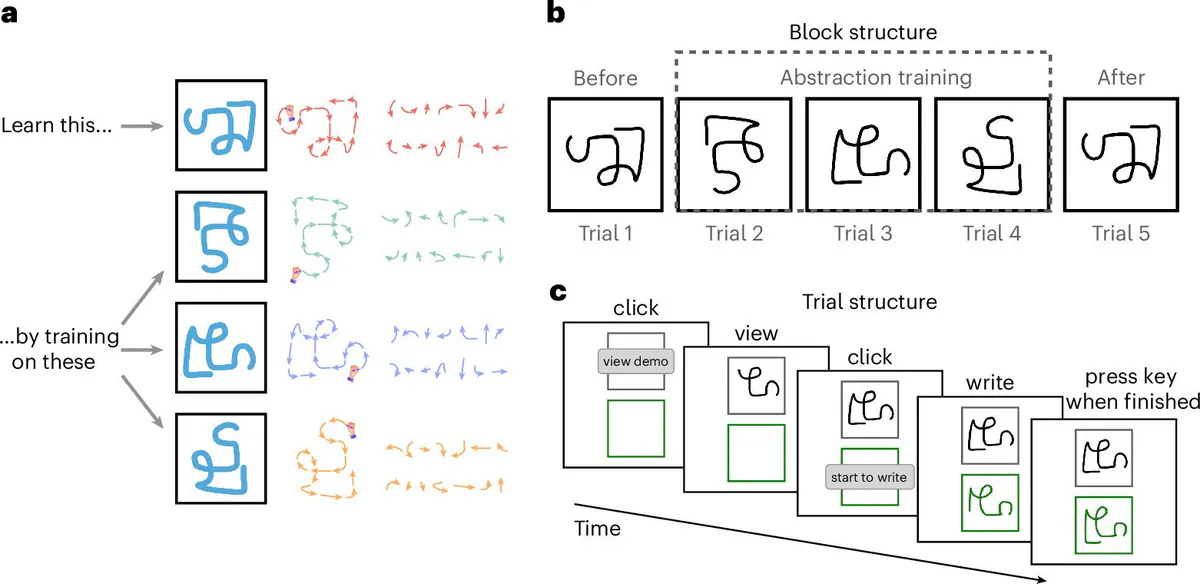
People learning unfamiliar drawing movements improved after practicing rotated versions that preserved the movements’ structure, Yale University researchers found. Across 11 online experiments, the results suggested that reusable action patterns can support learning from its earliest stages.
The study, by Zekun Sun, Zhiran Xie and Samuel D. McDougle, appeared in Nature Human Behaviour. Participants used a mouse or trackpad to reproduce unfamiliar symbols. Rotating those symbols altered the direction of hand movements but kept their sequence of turns and bends intact.
After three attempts at each rotated symbol, participants returned to drawing the originals. Their gains in accuracy and speed were about equal to those of participants who had practiced only the original versions, the researchers found.
Other tests examined whether the benefit came simply from familiarity with an image. Observing demonstrations produced smaller improvements, while drawing unrelated symbols offered no reliable benefit. Participants still improved when they practiced tracking a moving dot without a view of the complete symbol or a persistent drawing trace. Reversing the path during practice roughly halved the improvement afterward.
The findings support learning an ordered movement pattern, but do not establish how or where the brain stores it. Sun and McDougle emphasized that the gains were measured immediately during brief sessions. Whether benefits persist for days or weeks, or transfer to complex activities such as playing an instrument, remains untested.